
Do Blind People Trip on LSD? The Fascinating Truth About Psychedelic Experiences Without Sight
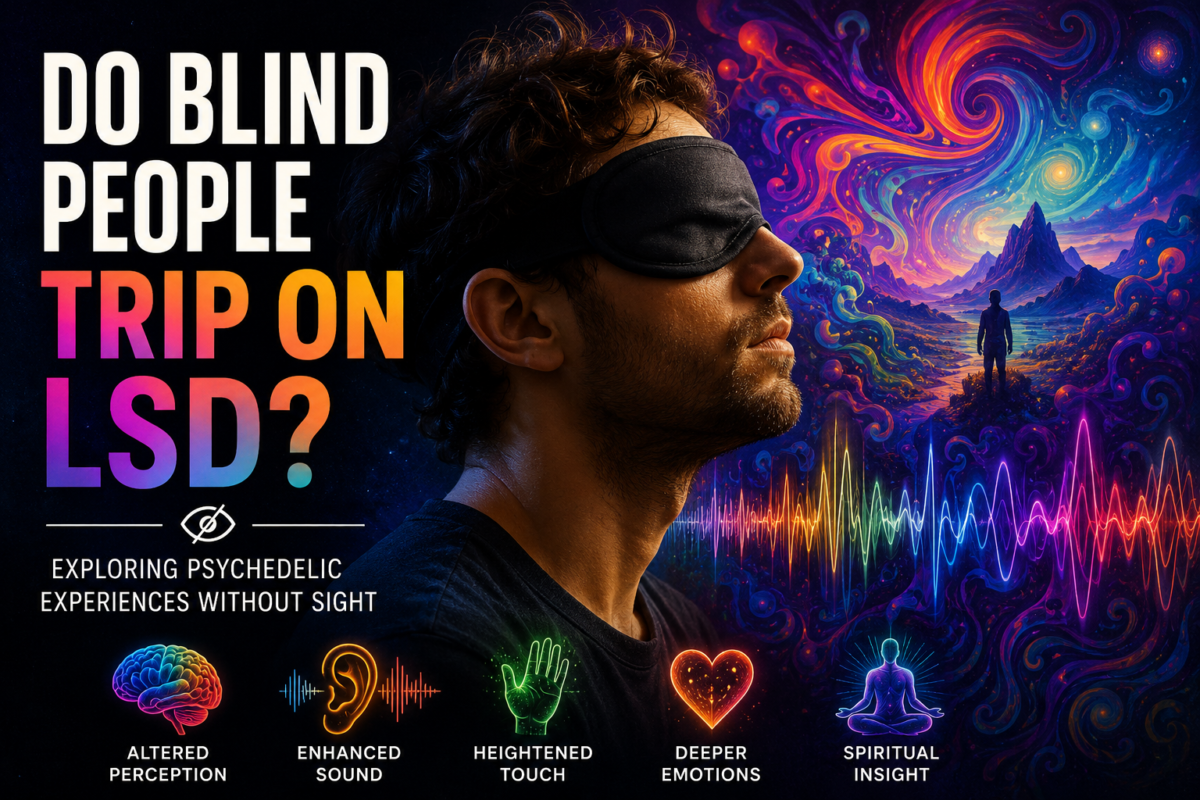
Have you ever wondered, do blind people trip on LSD? It’s one of those questions that instantly sparks curiosity. After all, when most people think about LSD, they imagine colorful visual hallucinations, geometric patterns, shifting landscapes, and vivid imagery. But what happens when someone has never seen the world in the first place?
The answer is far more fascinating than most people realize.
Psychedelic experiences aren’t solely about seeing strange colors or visual distortions. LSD affects consciousness itself, altering perception, emotions, thoughts, memories, and sensory processing. For blind individuals, these changes can create experiences that are every bit as profound—just different from what sighted people typically report.
Let’s dive into the science, stories, and mysteries surrounding the question: do blind people trip on LSD?
Understanding How LSD Works
Before answering whether blind people trip on LSD, it’s important to understand what LSD actually does.
LSD (lysergic acid diethylamide) primarily interacts with serotonin receptors in the brain, particularly the 5-HT2A receptor. This interaction causes significant changes in how the brain processes information.
Many people associate LSD with visual hallucinations, but visuals are only one aspect of the experience. Users often report:
- Heightened emotions
- Altered perception of time
- Deep introspection
- Enhanced imagination
- Increased sensory awareness
- Spiritual experiences
- Feelings of connectedness
In other words, LSD changes the way the brain interprets reality—not just what the eyes see.
So, Do Blind People Trip on LSD?
The short answer is yes, blind people can absolutely trip on LSD.
However, the nature of the experience depends largely on whether the person was born blind or became blind later in life.
This distinction is incredibly important because the brain develops differently depending on whether it has ever received visual input.
People Who Became Blind Later in Life
Individuals who had vision during childhood or adulthood often retain visual memories and neural pathways associated with sight.
When these individuals take LSD, many report experiencing visual hallucinations similar to those of sighted users.
Why?
Because their brains already know how to create visual imagery. Even though their eyes no longer provide information, the visual cortex can still generate internal images.
Imagine closing your eyes and picturing your childhood home. You’re not actually seeing it, yet your brain creates a visual representation. For someone who became blind later in life, LSD may amplify this ability dramatically.
Some have reported:
- Bright colors
- Moving patterns
- Faces
- Landscapes
- Dream-like scenes
In these cases, the psychedelic experience may include visual components despite the absence of functional vision.
What About People Born Blind?
Here’s where things get truly fascinating!
People who are congenitally blind—meaning they were blind from birth—typically do not experience visual hallucinations in the traditional sense.
Since their brains have never processed visual information, there are no visual memories to draw from.
But that doesn’t mean they don’t trip.
Far from it!
Many blind individuals report profound psychedelic experiences involving other senses.
Instead of seeing colors or patterns, they may experience:
- Intensified sounds
- Enhanced touch sensations
- Rich emotional journeys
- Altered body awareness
- Powerful thought patterns
- Deep spiritual insights
For someone born blind, a psychedelic journey may be dominated by sound, emotion, and physical sensation rather than vision.
The Brain’s Amazing Ability to Adapt
One reason this topic is so interesting is because of something called neuroplasticity.
The human brain is remarkably adaptable.
When someone is born blind, areas of the brain typically used for vision don’t simply sit idle. Instead, they often become involved in processing other senses.
Research has shown that blind individuals frequently have heightened abilities in:
- Hearing
- Spatial awareness
- Touch perception
- Memory tasks
As a result, psychedelic experiences may amplify these already enhanced sensory abilities.
Imagine hearing music and being able to perceive every tiny detail with astonishing clarity. Some blind users describe psychedelic states as immersive landscapes of sound and emotion.
That’s a trip—just not a visual one.
Real Reports From Blind Psychedelic Users
Although scientific studies on blind psychedelic users remain limited, several firsthand accounts have emerged over the years.
Some blind individuals describe experiences such as:
Sound Becoming Three-Dimensional
One recurring theme involves sound taking on a physical quality.
People report being able to “feel” music moving through space or experiencing sound as if it has texture and shape.
One individual described listening to a piano during an LSD experience and feeling as though the notes surrounded their entire body.
What an incredible way to experience music!
Emotional Depth
Many users report heightened emotional awareness.
Feelings may become richer, more intense, and more nuanced.
A simple conversation might feel profoundly meaningful. A memory could evoke overwhelming gratitude or wonder.
These emotional shifts can be just as transformative as visual hallucinations.
Altered Sense of Self
Some blind users describe experiences of ego dissolution—the sensation that the boundaries between self and world begin to fade.
This phenomenon is commonly reported among sighted psychedelic users as well.
It suggests that some of LSD’s most powerful effects occur independently of vision.
Why People Often Assume LSD Is All About Visuals
Popular culture has created a strong association between psychedelics and visual hallucinations.
Movies often portray psychedelic experiences as swirling rainbows, melting walls, and bizarre imagery.
While these effects certainly occur, they represent only one part of the psychedelic experience.
In reality, many experienced users say the most meaningful aspects involve:
- Self-discovery
- Emotional healing
- Personal insight
- Spiritual exploration
- Changes in perspective
The question “do blind people trip on LSD” helps reveal an important truth: psychedelics affect consciousness far beyond vision alone.
A Personal Example to Understand the Concept
Imagine attending a live concert.
Now imagine two people attending:
Person A focuses mainly on the visual aspects—the lights, stage effects, and performers.
Person B closes their eyes and focuses entirely on the music, emotions, and atmosphere.
Both people can have a powerful experience.
Similarly, while sighted psychedelic users may experience intense visuals, blind users often experience equally profound changes through other sensory and emotional channels.
The core experience remains deeply transformative.
What Does Science Say?
Scientific research directly examining blind individuals and LSD remains relatively limited.
However, studies involving psychedelics consistently demonstrate that these substances affect large-scale brain networks involved in:
- Perception
- Cognition
- Emotion
- Self-awareness
These networks exist regardless of visual ability.
Brain imaging research suggests psychedelics increase communication between regions that don’t normally interact extensively.
This may help explain why blind individuals can experience dramatic shifts in consciousness even without visual hallucinations.
Researchers continue exploring how psychedelics influence perception across different populations, and the experiences of blind individuals provide valuable insight into how consciousness itself works.
Can Blind People Experience “Visual” Concepts During LSD Trips?
This is one of the most debated questions.
For people who became blind after having sight, the answer is often yes.
For those born blind, the answer is more complex.
Many congenitally blind individuals understand concepts like color through language and association, but they do not experience color in the way sighted people do.
During psychedelic experiences, they generally report intensified versions of their existing sensory world rather than entirely new visual phenomena.
This suggests that LSD tends to work with the brain’s existing perceptual framework rather than creating completely unfamiliar sensory systems.
What We Can Learn From This Question
The question “do blind people trip on LSD” teaches us something surprisingly profound about human consciousness.
It reminds us that perception is much bigger than vision.
The mind can generate wonder, insight, emotion, and transformation through countless pathways.
Whether someone experiences colorful geometric patterns or immersive worlds of sound and feeling, the psychedelic experience can still be deeply meaningful.
In many ways, studying how blind individuals experience psychedelics helps researchers understand what consciousness really is—and how our brains create reality itself.
Final Thoughts: Do Blind People Trip on LSD?
So, do blind people trip on LSD?
Absolutely.
People who became blind later in life may experience visual hallucinations because their brains retain visual memories and pathways.
People born blind typically do not experience traditional visual hallucinations, but they can still have powerful psychedelic journeys involving enhanced sound, touch, emotion, introspection, and altered states of consciousness.
The experience may look different from the outside, but its depth and significance can be just as profound.
Ultimately, LSD is not merely a visual drug—it is a consciousness-altering substance. And consciousness extends far beyond what we see with our eyes.
The more we explore questions like these, the more we discover just how extraordinary the human mind truly is.