
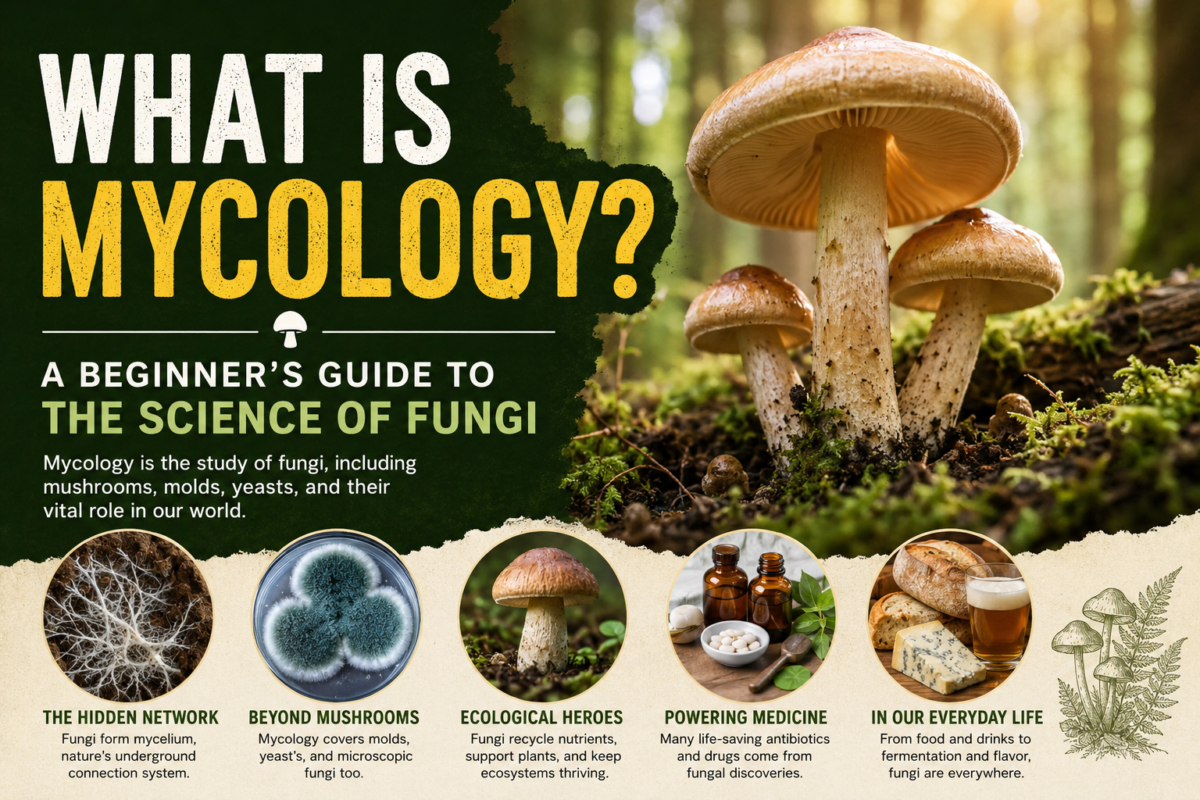
What Is Mycology? A Beginner’s Guide to the Fascinating World of Fungi
Have you ever walked through a forest after rain and noticed mushrooms popping out of the ground almost magically? Or maybe you’ve seen people growing mushrooms at home and wondered, “What exactly is mycology?” Well, you’re not alone! I remember the first time I heard the word mycology — I thought it sounded like something from a science-fiction movie. But once I discovered what it actually meant, I became fascinated by this hidden kingdom living all around us!
In this guide, we’ll explore what is mycology, why it matters, how fungi affect our daily lives, and why more people than ever are diving into this incredible field.
What Is Mycology?
Mycology is the scientific study of fungi. This includes mushrooms, molds, yeasts, and other fungus-related organisms. The word comes from the Greek word mykes, meaning fungus.
People who study fungi are called mycologists. These scientists explore how fungi grow, reproduce, interact with the environment, and even benefit humans.
At first glance, fungi may seem simple. After all, mushrooms just sit there, right? But wow — fungi are actually some of the most complex and important organisms on Earth!
Fungi are not plants, animals, or bacteria. They belong to their own biological kingdom entirely. That alone makes mycology a truly unique field of study.
Why Is Mycology Important?
You might be surprised to learn that fungi impact almost every aspect of life on Earth. Without fungi, ecosystems would collapse!
Here are just a few reasons mycology matters:
1. Fungi Decompose Organic Matter
Fungi break down dead plants, trees, and animals. Without them, forests would be buried under layers of dead material.
Imagine walking through a forest where nothing ever decayed. Crazy, right?
Mycologists study decomposition because it plays a critical role in nutrient recycling and soil health.
2. Mushrooms Are Used as Food
Many delicious mushrooms are edible and packed with nutrients.
Popular edible mushrooms include:
- Shiitake mushrooms
- Oyster mushrooms
- Lion’s mane mushrooms
- Portobello mushrooms
- Enoki mushrooms
I still remember trying sautéed oyster mushrooms for the first time. Honestly, I couldn’t believe how rich and meaty they tasted!
Mycology helps researchers improve mushroom cultivation, food safety, and nutrition.
3. Fungi Help Create Medicine
One of the biggest discoveries in medical history came from fungi.
The antibiotic penicillin was discovered from mold by Alexander Fleming in 1928. This breakthrough saved millions of lives.
Today, fungi are used to develop:
- Antibiotics
- Cholesterol-lowering drugs
- Immune suppressants
- Antiviral medications
Without mycology, modern medicine would look very different.
4. Fungi Support Plant Growth
Many fungi form partnerships with plants through structures called mycorrhizae.
These fungi connect with plant roots and help them absorb nutrients and water. In exchange, plants provide sugars to the fungi.
It’s basically nature’s underground internet system!
Scientists studying mycology often describe forests as interconnected fungal networks communicating beneath the soil.
The Different Types of Fungi
When learning what is mycology, it helps to understand the major types of fungi.
Mushrooms
These are the visible fruiting bodies many people recognize. Mushrooms release spores for reproduction.
Examples include:
- Button mushrooms
- Chanterelles
- Morels
- Reishi mushrooms
Molds
Molds grow as fuzzy colonies and are commonly found on old bread or damp surfaces.
Some molds are harmful, while others are incredibly useful in food production and medicine.
For example:
- Blue cheese uses mold cultures
- Penicillin comes from mold
Yeasts
Yeasts are microscopic fungi used in baking and brewing.
Every time bread rises or beer ferments, yeast is hard at work!
Honestly, it’s amazing to think fungi are responsible for pizza dough, bread, and even certain beverages.
What Do Mycologists Study?
Mycologists study fungi in many different ways. Some focus on the environment, while others work in medicine or agriculture.
Here are some major areas within mycology:
Medical Mycology
This branch studies fungal diseases affecting humans and animals.
Examples include:
- Athlete’s foot
- Ringworm
- Yeast infections
Medical mycologists work to understand infections and develop treatments.
Agricultural Mycology
Some fungi damage crops, while others improve soil quality.
Agricultural mycologists help farmers manage fungal diseases and improve crop production.
Environmental Mycology
These scientists study fungi in forests, oceans, and ecosystems.
They explore how fungi break down waste, recycle nutrients, and support biodiversity.
Industrial Mycology
Industrial mycology focuses on using fungi in manufacturing and biotechnology.
Fungi are used to produce:
- Enzymes
- Organic acids
- Biofuels
- Food ingredients
How Fungi Reproduce
One of the most fascinating parts of mycology is fungal reproduction.
Most fungi reproduce using tiny particles called spores.
Spores can travel through:
- Air
- Water
- Animals
- Human movement
Under the right conditions, spores germinate and form thread-like structures called hyphae.
Large networks of hyphae create a mycelium, which acts like the main body of the fungus.
Think of mushrooms as the “fruit” of a much larger underground organism!
The first time I learned that a mushroom is only a small visible part of a massive hidden network, my mind was blown.
Mycology and Mushroom Cultivation
In recent years, home mushroom cultivation has become incredibly popular.
People grow mushrooms for:
- Food
- Research
- Sustainability
- Personal hobbies
Common beginner mushrooms include:
- Oyster mushrooms
- Shiitake mushrooms
- Lion’s mane mushrooms
Growing mushrooms can feel surprisingly rewarding. Watching tiny pins transform into full mushrooms almost overnight is honestly exciting!
Many people enter the world of mycology simply because they start a small mushroom-growing kit at home.
Is Mycology Difficult to Learn?
Not at all!
At first, scientific terms may seem intimidating, but mycology becomes easier once you start exploring fungi in real life.
A great way to begin is by:
- Reading mushroom identification books
- Watching fungi documentaries
- Joining local mushroom groups
- Growing mushrooms at home
- Learning basic fungal biology
The best part about mycology is that there’s always something new to discover.
Even experienced mycologists constantly encounter unknown species and surprising fungal behaviors.
Fun Facts About Mycology
Here are some fascinating facts that make mycology even more interesting:
The Largest Organism on Earth Is a Fungus
A giant honey fungus in Oregon covers thousands of acres underground.
Yes — a fungus is larger than blue whales!
Some Fungi Glow in the Dark
Certain mushrooms produce natural bioluminescence.
Imagine walking through a dark forest and seeing glowing mushrooms. Incredible!
Fungi Can Survive Extreme Environments
Some fungi live in deserts, deep oceans, and even radioactive areas.
Scientists continue studying fungi for potential space exploration applications.
Common Misconceptions About Mycology
“All Mushrooms Are Dangerous”
Not true!
While some mushrooms are poisonous, many are edible and nutritious.
However, wild mushroom identification should always be done carefully.
“Fungi Are Plants”
Fungi are actually completely separate from plants.
Unlike plants, fungi do not perform photosynthesis.
“Mold Is Always Bad”
Some molds are harmful, but others are beneficial and essential for food production and medicine.
Careers in Mycology
If you’re passionate about fungi, there are many career paths available.
Mycologists may work in:
- Research laboratories
- Universities
- Agriculture
- Pharmaceuticals
- Environmental science
- Biotechnology companies
As interest in sustainability and fungal technology grows, careers in mycology are becoming more valuable than ever.
The Future of Mycology
The future of mycology is incredibly exciting!
Researchers are exploring fungi for:
- Sustainable packaging
- Eco-friendly building materials
- Plastic decomposition
- Carbon storage
- Alternative protein sources
Some companies are even creating leather-like materials from mycelium.
Honestly, fungi may help solve some of the world’s biggest environmental challenges.
Final Thoughts on What Is Mycology
So, what is mycology?
It’s the study of fungi — one of the most mysterious, important, and fascinating kingdoms on Earth.
From medicine and food to forests and sustainability, fungi shape our world in ways most people never realize.
The more you explore mycology, the more you begin to notice fungi everywhere. Trust me, after learning about mushrooms and mycelium, you’ll never walk through nature the same way again!
Whether you want to grow mushrooms at home, study fungal biology, or simply understand nature better, mycology opens the door to an incredible hidden world waiting to be explored.